

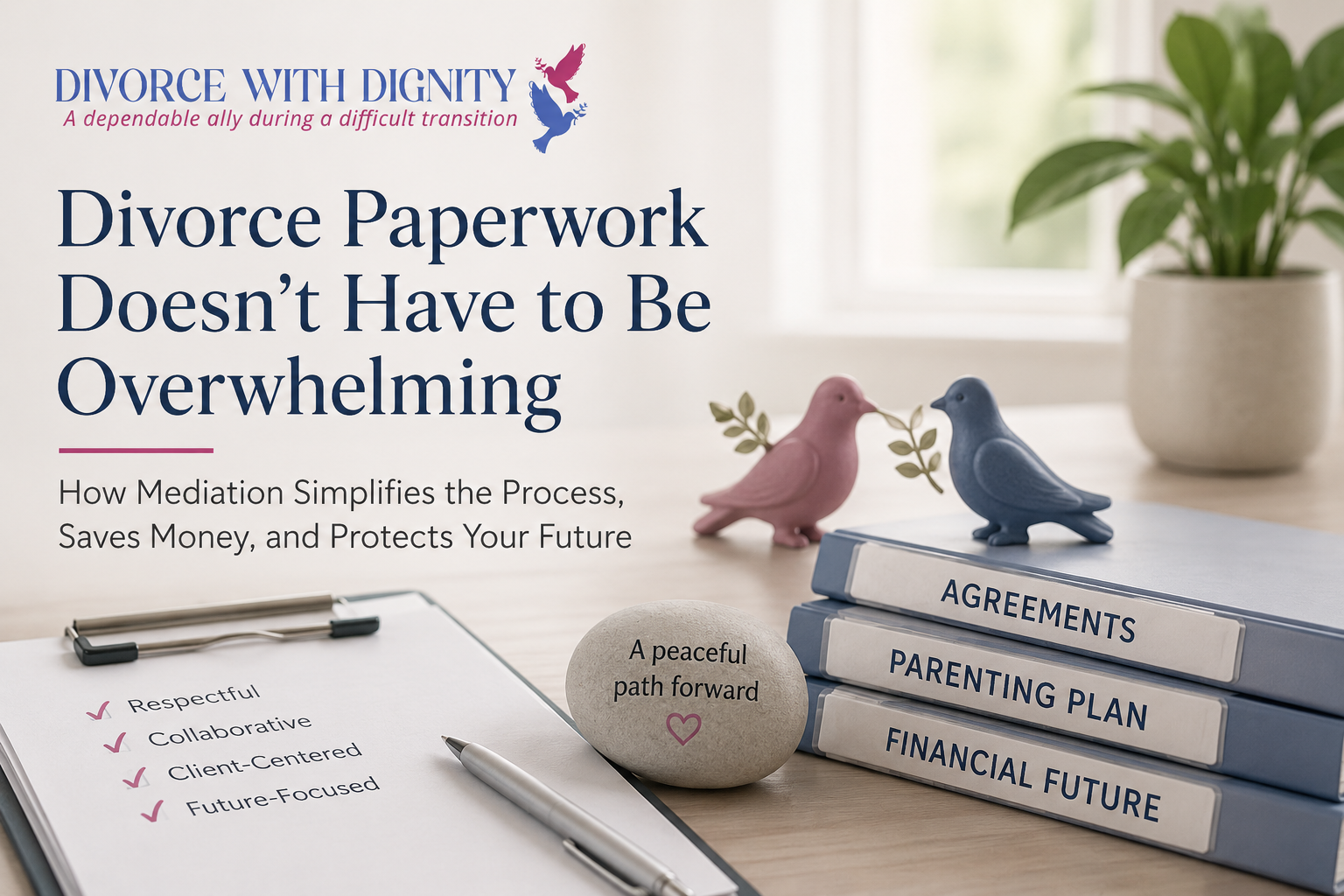
For many people, the thought of divorce paperwork is almost as stressful as the divorce itself.
There are forms to complete, financial information to gather, agreements to document, deadlines to meet, and legal requirements that vary by state. It’s common for individuals and couples to worry about making mistakes, missing important details, or getting lost in a process they never expected to navigate.
At Divorce With Dignity, we meet people every day who feel overwhelmed before they’ve even begun. They often ask questions like:
“How much paperwork is involved?”
“What if we agree on most things?”
“Do we still need attorneys?”
“Can mediation help with all the legal documents?”
“How can we avoid spending tens of thousands of dollars on a divorce?”
The good news is that divorce paperwork does not have to become a source of confusion, conflict, or unnecessary expense. When handled through a structured mediation process, the paperwork becomes part of a clear roadmap rather than a maze of legal obstacles.
As we move through 2026, more couples are seeking practical, respectful alternatives to traditional litigation. Mediation has become an increasingly popular option because it helps families stay focused on solutions rather than conflict while ensuring the necessary documents and agreements are completed correctly and efficiently.
Let’s take a closer look at how divorce paperwork works, how mediation simplifies the process, and why so many families choose this path.
Why Divorce Paperwork Feels So Overwhelming
Most people go through a divorce only once in their lifetime. Unlike buying a home or filing annual taxes, divorce introduces an entirely unfamiliar set of forms, legal terminology, and decisions.
Even in relatively amicable situations, divorce paperwork often involves:
- Financial disclosures
- Property division documentation
- Debt allocation agreements
- Parenting plans
- Child support calculations
- Spousal support agreements
- Court filing forms
- Settlement agreements
- Final judgment documents
Beyond the forms themselves, couples must make important decisions about their future.
Questions often include:
- Who stays in the family home?
- How will retirement accounts be divided?
- What happens to shared debt?
- How will parenting responsibilities be structured?
- What financial arrangements will support both households moving forward?
Without guidance, these decisions can feel intimidating.
The paperwork isn’t difficult simply because there are forms. It becomes difficult because every document represents a life decision.
The Hidden Cost of a Paperwork-Driven Divorce
Many people assume divorce paperwork is merely administrative.
In reality, paperwork often becomes the catalyst for conflict.
A simple disagreement over wording can trigger multiple attorney letters, court motions, and hearings. What starts as a minor issue can quickly become expensive and emotionally exhausting.
In a traditional litigated divorce, each spouse often has separate attorneys preparing, reviewing, revising, and negotiating documents. Every communication may generate billable time.
The result?
A process that frequently becomes:
- Slower
- More expensive
- More stressful
- Less collaborative
When families focus exclusively on legal positions instead of shared solutions, paperwork can become a battleground rather than a tool for resolution.
How Mediation Changes the Entire Experience
Mediation approaches divorce differently.
Instead of beginning with opposing legal strategies, mediation starts with conversation, problem-solving, and informed decision-making.
A trained mediator helps both spouses:
- Identify issues that need resolution
- Discuss options constructively
- Gather necessary information
- Reach mutually acceptable agreements
- Organize decisions into clear documentation
Rather than creating conflict, the paperwork reflects agreements that have already been thoughtfully developed together.
This shift changes the experience dramatically.
Instead of asking:
“How do I fight for my position?”
Couples begin asking:
“How do we create a workable future?”
That distinction often makes all the difference.
How Divorce With Dignity Simplifies Divorce Paperwork
At Divorce With Dignity, our process is designed to reduce confusion and increase clarity.
Our Providers guide clients through each stage of the process, helping them understand what documents are needed, what information must be gathered, and how agreements can be documented effectively.
This structured approach helps clients:
Stay Organized
Rather than guessing what comes next, clients receive guidance through each step of the process.
Reduce Errors
Mistakes on legal forms can create delays and frustration. Professional guidance helps ensure important information is addressed properly.
Make Informed Decisions
Paperwork should reflect thoughtful decisions, not rushed reactions.
Move More Efficiently
When agreements are reached collaboratively, the entire process often moves more smoothly than a contested court case.
Focus on the Future
Instead of reliving past conflicts, mediation helps families concentrate on practical solutions moving forward.
One of the Biggest Questions: Do We Need a Lawyer?
This is one of the most common questions we hear.
The answer depends on your specific circumstances.
Many people assume that every divorce requires two attorneys battling through negotiations. In reality, many couples successfully complete mediated divorces without engaging in prolonged litigation.
That said, mediation and legal advice serve different purposes.
A mediator is a neutral professional who helps facilitate productive discussions and develop agreements.
An attorney provides legal advice to an individual client.
Many Divorce With Dignity clients choose one of several approaches:
- Mediation only
- Mediation with independent legal review
- Mediation combined with consulting attorneys
- Mediation followed by attorney review of final agreements
For many families, having a mediator guide the process and an attorney review the final agreement provides an effective balance of support and cost control.
The key distinction is that mediation allows couples to work toward solutions together rather than immediately entering an adversarial process.
How Much Money Can Mediation Save?
Every divorce is unique, so exact savings vary.
However, mediation is widely recognized as one of the most cost-effective approaches to divorce.
Traditional litigated divorces can involve:
- Attorney retainers
- Court appearances
- Discovery requests
- Depositions
- Expert witnesses
- Motion hearings
- Trial preparation
Each step can significantly increase costs.
In contrast, mediation focuses on resolving issues collaboratively before they escalate into expensive disputes.
For many families, mediation can reduce divorce-related expenses by thousands—and sometimes tens of thousands—of dollars compared to fully litigated divorces.
More importantly, mediation often preserves resources that families need for:
- Children’s expenses
- Housing
- Education
- Retirement planning
- Establishing separate households
When families spend less on conflict, they have more resources available for rebuilding their futures.
What If We Don’t Agree on Everything?
Many people mistakenly believe mediation only works for couples who already agree on every issue.
In reality, most couples begin mediation with unresolved concerns.
Common areas of disagreement include:
- Parenting schedules
- Property division
- Financial support
- Debt allocation
- Future communication expectations
Mediation exists precisely because these issues need discussion.
The goal isn’t immediate agreement.
The goal is creating a structured environment where productive conversations can occur.
A skilled mediator helps couples move through disagreements thoughtfully and constructively.
Many clients are surprised by how much progress becomes possible when discussions are guided by a neutral professional focused on solutions rather than positions.
What About Children?
When children are involved, divorce paperwork becomes even more important.
Parenting plans help establish expectations regarding:
- Parenting schedules
- Holidays
- School decisions
- Medical decisions
- Communication guidelines
- Future conflict resolution
Mediation provides parents with an opportunity to design parenting arrangements tailored to their family’s needs.
Rather than having a court impose a schedule, parents can work together to create practical solutions that support stability and consistency for their children.
This collaborative approach often lays the foundation for healthier co-parenting relationships after the divorce is finalized.
The Emotional Benefits of Mediation Often Matter Most
While financial savings receive significant attention, many clients tell us the emotional benefits are even more valuable.
Divorce is a major life transition.
People often experience:
- Uncertainty
- Grief
- Anxiety
- Fear about the future
- Concerns about their children
- Financial stress
An adversarial process can intensify these emotions.
Mediation often provides a different experience.
Because discussions focus on communication, understanding, and problem-solving, clients frequently report feeling:
- More informed
- More empowered
- Less overwhelmed
- Better prepared for life after divorce
The process helps people move through divorce with greater clarity and confidence.
Why More Families Are Choosing Mediation in 2026
Today’s families increasingly seek divorce solutions that align with their long-term goals.
Many people no longer view divorce as a battle that must produce winners and losers.
Instead, they want:
- Efficiency
- Transparency
- Respect
- Financial responsibility
- Child-focused solutions
- Reduced conflict
Mediation supports these priorities.
As awareness grows about the emotional and financial costs of litigation, more couples are discovering that a mediated approach can provide the structure they need without escalating conflict.
For many families, mediation offers a path that feels more aligned with the future they hope to create.
Divorce Paperwork Is Really About Building the Next Chapter
It’s easy to think of divorce paperwork as forms, signatures, and legal requirements.
But in reality, these documents represent something much more significant.
They define:
- Future parenting relationships
- Financial arrangements
- Property ownership
- Household transitions
- Long-term family stability
The process deserves thoughtful attention and professional guidance.
When approached through mediation, paperwork becomes more than a legal requirement.
It becomes a framework for moving forward.
Instead of focusing on what is ending, mediation helps families focus on what comes next.
And that shift can make an enormous difference.
The Divorce With Dignity Difference
At Divorce With Dignity, we believe divorce can be handled with respect, clarity, and care.
Our Providers help clients navigate difficult decisions while reducing unnecessary conflict and confusion. Through mediation and structured support, we help families create workable agreements, understand the required paperwork, and move toward a more stable future.
Divorce is never easy.
But the process does not have to be overwhelming.
With the right guidance, families can navigate divorce paperwork confidently, make informed decisions, and create a foundation for the next chapter of life.
If you’re considering divorce and want to learn more about mediation, connect with a Divorce With Dignity Provider and discover how a thoughtful, collaborative approach can help you move forward with greater peace of mind.
Find a Provider near you: https://dwdignity.com/all-providers/
Frequently Asked Questions About Divorce Paperwork and Mediation
What paperwork is required for a divorce?
The required paperwork varies by state, but commonly includes divorce petitions, financial disclosures, parenting plans (when children are involved), settlement agreements, and final court documents. A Divorce With Dignity Provider can help you understand what documents may be needed in your situation.
Can mediation help with divorce paperwork?
Yes. Mediation helps couples reach agreements on important issues, and those agreements are then documented in the necessary paperwork. This often makes the process more organized and efficient.
Do both spouses need lawyers if they use mediation?
Not necessarily. Many couples complete mediation without retaining separate litigation attorneys. Others choose to have an attorney review their final agreement before filing. The right approach depends on your circumstances and comfort level.
Is mediation legally binding?
The agreements reached in mediation can become legally binding once they are properly documented, signed, and approved by the court according to state requirements.
How much cheaper is mediation than traditional divorce?
Costs vary significantly, but mediation is often substantially less expensive than a fully litigated divorce because it reduces attorney involvement, court appearances, and prolonged disputes.
What if we disagree about parenting arrangements?
Parenting disagreements are common. Mediation provides a structured environment where parents can discuss concerns, explore options, and work toward child-focused solutions.
Can mediation work if communication is difficult?
Yes. In fact, many couples seek mediation because communication has become challenging. A neutral mediator helps facilitate productive conversations and keep discussions focused on solutions.
Is mediation only for couples who get along?
No. Most couples entering mediation have unresolved issues. The purpose of mediation is to help navigate disagreements constructively and reach workable agreements.
How long does a mediated divorce take?
The timeline depends on the complexity of the issues involved, state requirements, and how quickly information is gathered. Many mediated divorces are completed more efficiently than litigated cases.
What are the biggest benefits of mediation?
The most commonly reported benefits include lower costs, reduced conflict, greater privacy, improved communication, more control over decisions, and a smoother transition for families moving forward.
If you’re considering divorce and want to learn more about mediation, connect with a Divorce With Dignity Provider and discover how a thoughtful, collaborative approach can help you move forward with greater peace of mind.
Find a Provider near you: https://dwdignity.com/all-providers/


